
Hardware Design
3D Printing and Fabrication
This chapter organizes the mechanical build around two fabrication paths:
- parts that can be produced with additive manufacturing
- parts that should be outsourced because they require higher strength, tighter tolerances, or a different process
Part Naming Convention
We named the CAD files so you can quickly identify the required material for each part. Each part name includes a fabrication-code letter indicating its intended manufacturing method and material family:
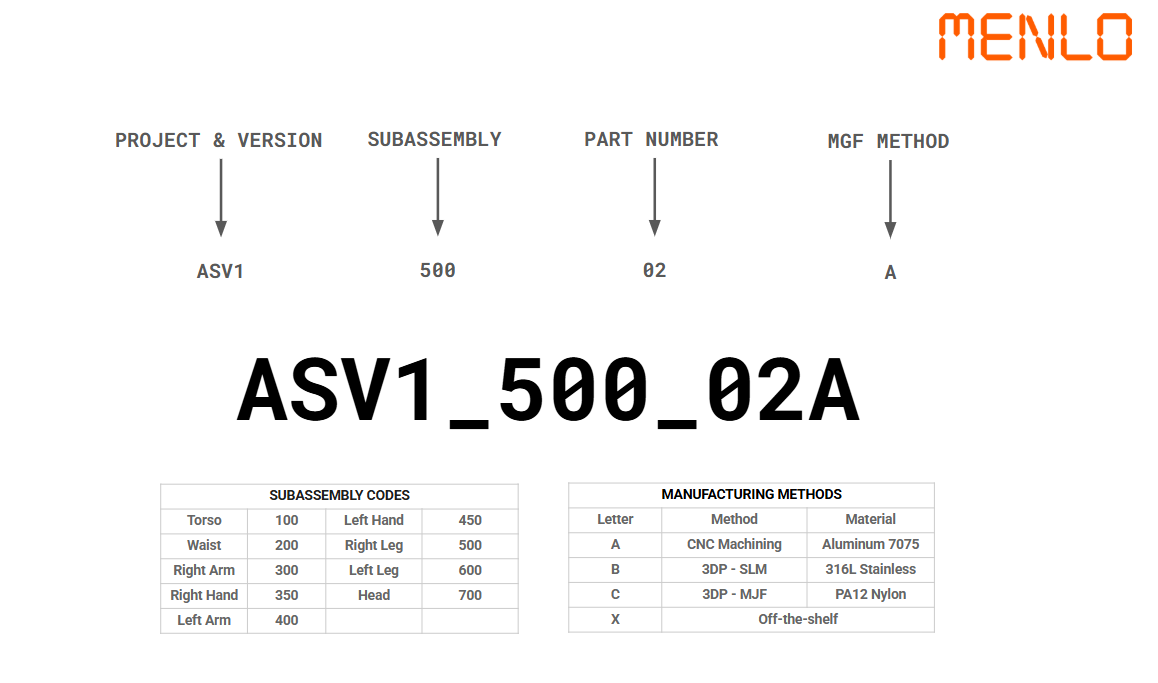 Figure: Naming convention for the part manufactorying
Aparts are not standard 3D printed parts. If a part is labeled as Aluminum 7075, it should be CNC machined.Bparts are 3D printable in 316L stainless steel, but only with a metal printing process that supports SLM 316L.Cparts are 3D printable in PA12 nylon, but only with a polymer printing process that supports PA12, such as SLS or MJF.Xparts are off-the-shelf components and should be purchased directly rather than fabricated.
NOTE:
- The fabrication method must match the material code in the part name.
- Making parts with FDM 3D printing will not guarantee the tolerances and required strength for the system.
You can also refer to Mechanical Design Frame to identify which module each part belongs to by mapping part indices to the module part lists.
After gathering all the parts, you can start preparing the tools and continue into assembly!
How is this guide?